
Training Library
Everything your teams can practice, from full conversations with AI characters to five-minute drills on a single skill.
Roleplays
Hold a real conversation with an AI character who answers back and pushes where you're weakest. Every roleplay ends with feedback, and you can talk it through with a coach afterwards.
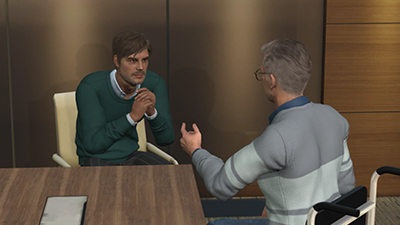
Practice with AI avatars in a range of scenarios, from giving a disciplinary to a poor performance review.

Practice with AI-powered customers in a range of scenarios, from dealing with angry customers to billing issues.

Pitch your product or service to three AI-powered investors in this Shark Tank/Dragon's Den styled scenario.
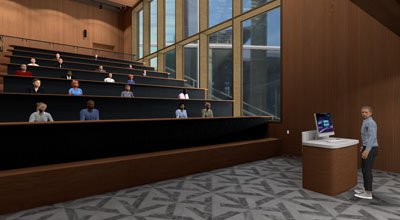
Practice your debating skills on any topic with AI-powered avatars. Moderated or one-on-one debate.
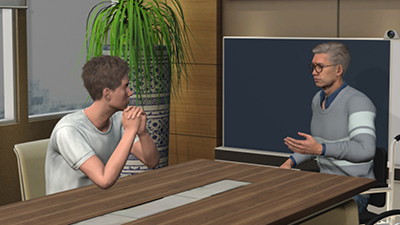
Practice concise and effective communication while answering interview questions from AI-powered avatars.

Practice with an AI-powered avatar in a doctor's office. Aimed at healthcare professionals who will be talking to patients.

Practice mentoring in a range of scenarios, from junior staff members to someone who wants a career change.


Pitch to new sales prospects, answer questions, and receive feedback on your performance.

Practice giving both positive and negative feedback to your colleagues in the workplace.
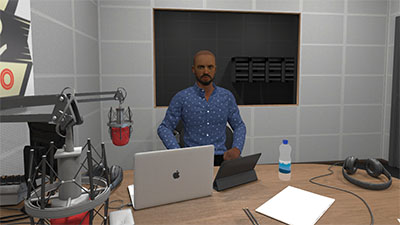
Practice being interviewed on TV, radio, or a podcast. Answer questions and receive feedback.

Practice pitching yourself, your company, or your product in two different elevator scenes.
Public Speaking
Step into a room, deliver a full talk to a virtual audience, and get scored on how you did. Every session ends with feedback, and you can talk it through with a coach afterwards.
Upload your slides, pick the venue and deliver it start to finish - a minimum of thirty seconds, or as long as the real thing. The audience shifts, checks phones and looks up, so you practice reading a room rather than reciting to an empty one.
Conference Room
Auditorium
TEDx Styled Theatre
Lecture Hall
Event Hall
Meeting Room
Boardroom
Office Room
Classroom
Computer Room
Press Conference
Training Delivery

Skills Coaching
A one-to-one session where you work through a situation you're actually facing, and finish with a written plan you can act on.
Bring the conversation you're worried about. The coach asks what happened, what you've tried and what you're avoiding, then works with you on an approach. You leave with a report setting out your plan and what to watch for.
How to Give Feedback (SBI)
Listening for the Bigger Picture
Draft Your Elevator Pitch
Crafting a Sales Pitch Story
Paraphrasing for Active Listening
and four more
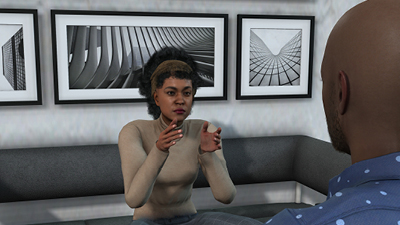
Exercises
Short exercises on one part of speaking at a time - your pace, your eye contact, thinking on your feet. Most take under ten minutes.
Where a full talk gets you an overall score, these isolate a single thing so you can work on it in a few minutes. Some are scored, some are rehearsal tools you review yourself.

Enhance your collaboration skills by practicing in simulated scenarios, tailored to different personality types.

Practice how to deliver successful video-conferencing presentations on Zoom, WebEx, Teams, and more.

Practice thinking on your feet by talking about a wide range of random images.

A variety of listening exercises, including the Goldilocks exercise and a conference call.

Experience being ambushed by the media in a hotel lobby and practice answering hostile questions.

Improve your eye contact and review your performance with gamification and heatmaps.

Sound and Visual Distractions
Learn how to deal with distractions, including mobile phones ringing and lighting.
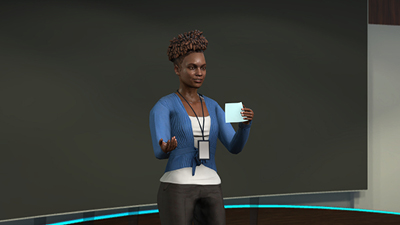
Practice organizing your thoughts by answering questions under time pressure (game by Toastmasters).

Practice answering questions after your presentation using a 4 step process.

Practice your networking skills and build stronger connections with people at two events.

A strength training workout to warm up your voice and develop your pitch, pace, pause, and projection.

Practice your storytelling by talking about a given topic and incorporating new words as you go.

Deliver a presentation and then watch yourself back to self-evaluate your body language.
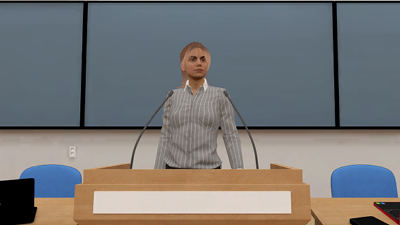
Exercises to measure your speaking pace and help you understand how different speeds sound.

This exercise helps you learn your speech, starting with the main points and then the sub-points.