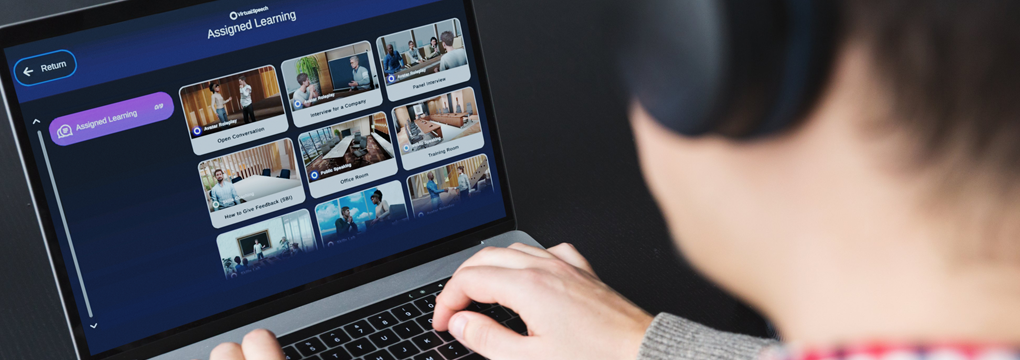

L&D teams face a tough task right now. Proving training’s return on investment is difficult, learners face more time-pressure than ever before, and engagement with learning content is often lower than expected.
But despite these challenges, it’s still possible to launch successful training programs that resonate with learners and make a real impact on business outcomes – with more and more teams turning to VirtualSpeech, a purpose-built platform that supports L&D initiatives and helps organizations accelerate their training success.
Here’s how some of the world’s leading organizations have built great learning experiences with the help of VirtualSpeech:

Bayer: Launch Loud, Start Small
When Bayer, one of the world’s leading healthcare organizations, rolled out AI roleplays for workplace communication, the team knew an email announcement wouldn’t be enough.
Instead, they ran launch events and town halls where employees could try the roleplays in VR headsets, then invited them to keep practicing on desktop in their own time. Those first users became internal champions and encouraged their colleagues to try it.
Bayer also avoided rolling out to everyone at once. The team started with the employees working cross-culturally the most, ironed out any issues, and then expanded to other global teams. The program has since grown to include negotiation training for procurement and interview practice for employees moving into new internal roles.
The takeaway: A strong launch and a focused first cohort give you the advocates you need to scale.
Read the full story: Bayer’s Playbook for Success

Vodafone: Make Training Feel Familiar
Vodafone wanted employees to build their public speaking skills in a setting that felt like their own. The idea was to recreate the Vodafone UK Pavilion in virtual reality, allowing employees to upload their own slides and notes, present to a virtual audience, and get instant feedback.
The VirtualSpeech team visited the Pavilion for reference before designing and building the virtual version, sharing progress with Vodafone along the way. The finished environment included Vodafone branding throughout and a virtual audience ready to listen.
The response was clear. 93% of employees said they would recommend VirtualSpeech to a colleague, and 91% said they wanted more immersive training at Vodafone. Employees can now practice on demand before real presentations, while managers use the performance data to spot skill gaps.
The takeaway: When training takes place somewhere learners recognize, the connection to their real job is obvious from the start.
Read the full story: Vodafone case study
Deutsche Telekom: Open the Door to Everyone
Deutsche Telekom operates in more than 50 countries, and with digitization changing roles across the industry, its employees need to keep building new skills to keep up. VirtualSpeech was brought in to support that learning culture.
Deutsche Telekom’s program started with public speaking training and has since grown to encompass business storytelling, active listening practice, and more of VirtualSpeech’s training offerings.
Every employee, at any level, has access to an All Access program, allowing them to learn flexibly and in their own time. VR sessions are also used as a reward for exceptional progress, which gives employees further motivation to get involved.
The data was clear: 1,200+ employees have completed the training so far, with each session delivering an average skills improvement of 10%. The result was employees that are more engaged and excited about learning, and better prepared for challenging client situations.
The takeaway: Open access and a reason to take part make training easy to say yes to.
Read the full story: Deutsche Telekom case study

Severn Trent: Let Demand Do the Talking
Severn Trent, one of Britain’s largest water companies, had been running presentation skills training for some time. The catch was that the only way employees could practice what they’d learned was by presenting face-to-face to the rest of their group.
The team chose VirtualSpeech for its realistic environments, with immersive scenarios now forming part of Severn Trent’s courses on Presenting, Personal Brand, and Career Development.
The results speak for themselves. The buzz around VirtualSpeech led to fully booked courses and additional sessions, and learner satisfaction scores rose significantly. Employees have spent more than 11,000 minutes practicing with VirtualSpeech, and the program has saved over 120 hours of training time to date.
The takeaway: When employees start filling up sessions and asking for more, you know the training is landing.
Read the full story: Severn Trent case study
Canadian Women’s Chamber of Commerce: Create a Safe Place to Practice
The Canadian Women’s Chamber of Commerce (CanWCC) represents more than 1.2 million women and gender-diverse business owners and self-employed people across Canada. Its Control the Conversation course teaches women founders how to recognize and disrupt the unconscious bias they can face when seeking financing.
The course covered the theory well, but CanWCC wanted participants to actually practice those conversations. That’s hard to recreate in a realistic way, and CanWCC had started building its own prototype. Then the team discovered VirtualSpeech, which did what they needed and more.
Using Roleplay Studio, CanWCC built custom scenarios around conversations with angel investors, lenders, and venture capitalists, with each one including realistic levels of unconscious bias. Founder and CEO Nancy Wilson described the result as “a safe, risk-free environment” where participants could build confidence.
The course launched to 40 students in January 2026, with CanWCC planning to run it several times a year and expand practice exercises to other parts of its offering.
The takeaway: People practice high-stakes conversations more when they know a mistake won’t cost them anything.
Read the full story: CanWCC case study

PwC: Get Security on Your Side Early
Before a new training platform reaches a single learner, it usually has to get past IT, security, and legal. For many L&D teams, this is where a promising rollout stalls.
PwC is one of the world’s leading professional services firms, and at the 2024 LegalTech conference, it collaborated with VirtualSpeech to deliver AI-powered negotiation training to legal professionals. Negotiation practice can involve sensitive information, so PwC needed a platform that could prove its data security before anyone used it.
PwC’s internal risk team put VirtualSpeech through a series of rigorous privacy assessments and scenario-based testing. They tried to push the AI roleplays beyond their intended negotiation boundaries, and the platform held firm. VirtualSpeech is also protected against LLM security threats such as prompt injections and jailbreaks.
The assessment confirmed that VirtualSpeech’s data practices align with GDPR and ISO/IEC 27701, and that its AI governance aligns with ISO/IEC 38507:2022. The collaboration is also featured in techUK’s Ethics in Action report.
The takeaway: When security and compliance are answered upfront, your rollout doesn’t lose momentum waiting for sign-off.
Read the full story: PwC case study
Build Training Your People Actually Use
Each of these organizations took a different route, but they all made training relevant, easy to access, and worth coming back to. That’s what gets employees engaging.
If you want to see how VirtualSpeech could boost training adoption rates in your organization, book a demo. And for a deeper look at every stage of adoption, download our free guide, Beyond Completion: Building Training That Learners Actually Use.