

Communication with others is at the center of almost everything in our daily lives. Whether you’re at home, in school, or in the workplace, you need effective communication skills to thrive and succeed.
Communication skills are the key to establishing healthy relationships with loved ones, bosses, interview panels, colleagues, and business contacts, to name but a few audiences.
In this article we’ll break down:
- Why effective communication skills are important
- Communication in the workplace
- Why communication is more important than ever in the age of AI
- The characteristics of an effective communicator
- List of the most important communication skills
- How to improve your communication skills (with resources)
The importance of communication skills can’t be overstated – becoming a good communicator is one of the best ways to open opportunities and improve your career prospects.
The Importance of Communication Skills
With the advances in digital technology, good communication skills, both in-person and online, are more important than ever. A well-crafted speech or email can help you avoid potential issues, enhance your reputation and persuade others of your ideas.
Actively improving your communication skills plays an important role in the process of personal development and career progression. You’ll be able to communicate your message more clearly, and you’ll find that people are more willing to tell you information they otherwise wouldn’t have.
Effective communication involves both speaking and listening, while understanding a message and the intention behind it. Communication skills are important to many aspects of your life and career, including:
- Managerial roles: How do you command respect from your colleagues while building a strong culture and team spirit? How do you deal with an unexpected crisis and communicate your action plan to your team? Verbal communication skills are essential for many areas of management.
- Workplace success: You’ll frequently be talking to clients, customers, talking in team meetings, requesting information, giving feedback and discussing problems. All require strong communication skills so that you are understood clearly without any misinterpretation.
- Securing a new job: In employer surveys, oral communication skills consistently rank amongst the top soft skills companies look for. They want new employees to be able to speak clearly, concisely and confidently.
- Advancing your career: It’s important to be able to communicate your thoughts on how processes, products or services can be improved. Businesses value these skills, especially in management positions. Business communication becomes essential as you climb the career ladder.
Communication in the Age of AI
It goes without saying that artificial intelligence (AI) has become a powerful force in both the workplace and the wider world. From chatbots handling customer inquiries to intelligent virtual assistants, AI coaches, and machine learning algorithms, AI is changing the way we work and interact with one another.
However, despite its many benefits, AI cannot replace the need for authentic human interaction and communication – and strong communication skills are essential for working with AI too.
The key points to remember are:
- AI requires good communication skills to be maximized: From prompting LLMs efficiently to interpreting, understanding, and communicating AI agent outputs to others, it’s impossible to get the best out of AI without communicating well – to both AI and your fellow humans.
- AI can’t fully replace human interaction: The most critical conversations in life will still be human-to-human. While AI-powered chatbots can handle basic customer inquiries for example, human team members are needed to focus on complex or in-depth interactions.
- The importance of teamwork and collaboration transcends AI: Effective communication is key to helping teams to work together and achieve their goals. Whether you use AI or not, you need to be able to communicate effectively with your peers to succeed.
Considering all the factors, communication skills remain critical even as AI becomes ever more popular.
Characteristics of an Effective Communicator
Becoming an effective communicator doesn’t involve mastering just one skill – it actually requires you to be proficient in a number of closely related traits. Together, these attributes combine to create a confident, effective communicator.
Let’s look at the most important in more detail:
Active Listening
Using your ears may seem like a strange place to start when discussing communication skills. However, it’s a fundamental aspect that enables many of the other skills outlined in this article.
There are two major advantages to developing good listening skills. Firstly, you gain the respect of your audience. People who appear to half-listen, waiting for a chance to speak again themselves, or who interrupt constantly, are frustrating to communicate with.
On the other hand, an active listener – someone who gives their full attention to other people while they speak – is more likely to enjoy a receptive audience when they communicate.
Secondly, active listening allows you to expand your knowledge of (and empathy towards) your audience. From listening comes an appreciation of what interests them, and the sort of questions, concerns and motivations they have.
Keep in mind that listening actively doesn’t mean simply staying quiet while someone speaks and waiting your turn. It means paying attention, acknowledging and understanding what the other person is saying, and using an open body stance and an animated face to show that you’re genuinely engaged.
Your active listening should then inform your follow-up questions and enable a deep, meaningful back-and-forth conversation.
Use of Non-Verbal Techniques
Non-verbal communication can be just as, if not more important than verbal communication. Your body language sends strong signals, and can encourage people to talk to you freely and confidently. Negative body language, however, can make you seem unapproachable and cold.
Maintaining good eye contact (50% of the time while talking, 70% while listening) and displaying an open body stance (no crossed arms or slumped posture) goes a long way to making your audience feel comfortable and receptive to what you are saying.
Eliminating these subtle barriers to effective communication can make a big difference to your ability to get your message across.
It’s important to remember that non-verbal communication isn’t an exact science and at times you’ll need to use discretion or your own judgement.
For example, when speaking to someone about sensitive topics, or engaging with someone who is shy, you may need to adjust your body position or eye contact, to help them feel more comfortable.
With time, experience, and practice, you can learn how to send the right signals non-verbally.
Communicating with Clarity and Purpose
Effective communication – especially in the workplace – requires precision. When you communicate, you’re usually communicating with a purpose. For example, to educate, warn, inform, influence, or persuade.
The best communicators can choose the information needed to achieve that purpose. Clear, succinct and to the point (Remember, you can always preface what you say with an invitation to ask for more detail if needed).
In general, however, keep your central points focused on your end goal. The more you ramble, use jargon, or use flowery sentences, the more distracted your audience is likely to be.
Choosing the Right Delivery Mechanism
Communication comes in many different forms: spoken, written, non-verbal, and more. And knowing the best approach to take to deliver your message is an essential skill.
With an appreciation of what your audience’s needs and expectations are, comes clarity on the best way to communicate with them to achieve your communication goal.
For instance, emails are the default in most workplaces – but is it always the best choice? Depending on the topic or goal, a one-to-one meeting or a telephone call may be a better option. Delivering a presentation or speech? Consider whether an accompanying slide deck will make it more engaging, or take away from the message.
It’s always worth thinking about the format in which you deliver your communications. When you do, you’re more likely to achieve your objective.
Showing Empathy and Respect
Empathy and respect are important life skills, and as a result they also play a key role in effective communication.
Part of this means being an enthusiastic participant in the conversation and being patient should others not understand your point immediately. Factors we mentioned earlier, such as active listening, also play an important role in demonstrating empathy and respect for your audience.
A warm tone, respectful approach, and an open mind can go a long way to helping your audience feel comfortable and appreciated during discussions – even if you’re having a difficult conversation or delivering bad news.
In conversations, try to show awareness of other people’s emotions and take into consideration what they may be thinking or feeling. Use this to formulate the information you’re communicating in a way that matches your audience’s preferences, knowledge level, and expectations.
Simply put, understanding your audience is key to communicating in a way they’ll resonate with.
Confidence
Confidence in your communication skills allows you to come across as authentic, authoritative, and worthy of being listened to.
Often, confidence is the final piece of the puzzle – you’ll start feeling more and more confident in conversations as you continue applying other communication best practices in real situations.
A confident communicator is a good communicator, so trust in your abilities. “Fake it till you make it” is a great attitude to have, as self-belief is a crucial factor. If you act like you’re confident, you’re more likely to feel confident and forget about any doubts you may have.

Don’t beat yourself up if you don’t immediately feel confident in your communication skills even after practicing. Confidence in communication is a long-term soft skill, something you build up over time through repetition. Try reflecting on your progress over the course of 6 months, or a year instead – that’s where improvement will be most noticeable.
List of the Most Important Communication Skills
We’ve covered some of the most important elements of effective communication, but there are dozens of factors that can affect your ability to communicate. Here’s a wide range of relevant skills and traits to help you assess where you might need to improve:
- Active listening
- Articulation
- Assertiveness
- Audience understanding
- Body language
- Clarity
- Concision
- Confidence
- Conflict management
- Creative thinking
- Debating
- Diplomacy
- Emotional intelligence
- Empathy
- Eye contact
- Facial expressions
- Friendliness
- Grammar
- Humour
- Imagination
- Improvisation
- Logical thinking
- Negotiation skills
- Nonverbal communication
- Open-mindedness
- Persuasiveness
- Presentation
- Public speaking
- Quick thinking
- Reading body language
- Speech writing
- Storytelling
- Teamwork
- Timing
- Verbal Communication
- Vocal tone and pitch
Acknowledging the importance of, and then improving these skills will help you become a more effective communicator.
How to Improve Your Communication Skills (With Resources)
In this day and age, there are a number of easily-accessible ways to improve your communication skills and become a more effective communicator. From free online videos all the way through to intensive courses, the amount of choice can be overwhelming. We’ll cover the most popular options to help you make the right decision:
Practice
Nothing beats experience. Putting yourself in situations where you have to communicate with others is one of the best ways to improve your communication skills.
At work, for example, you might volunteer to deliver a presentation to your colleagues to help you practice public speaking. Or if written communication is the area you’re aiming to improve, offering advice to your peers in an online forum might be an option.
The more you experience situations like these, the more comfortable you’ll begin to feel. You will naturally begin to feel less anxious or nervous about a situation if you’ve experienced it many times before.
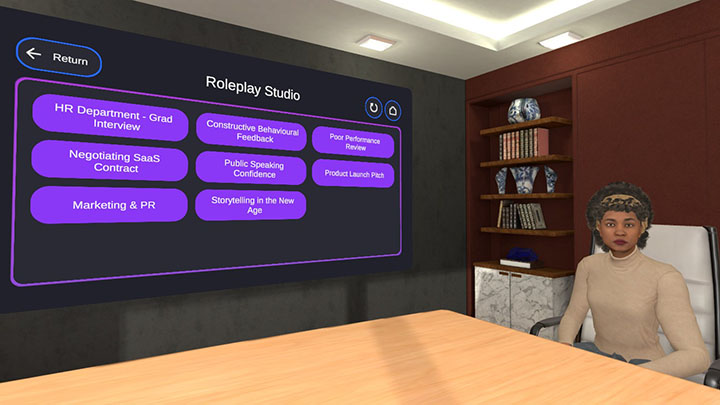
VirtualSpeech can help you practice in a safe environment, where you’re free to make mistakes without fear of judgement. Our app puts you in realistic, immersive public speaking situations, allowing you to practice common communication scenarios and receive feedback on your performance.
Books
Books on communication and public speaking can provide you with insights into the theory behind what sets good communicators apart.
Classics such as How to Win Friends and Influence Peopleby Dale Carnegie or The Art of Public Speaking by Stephen Lucas are excellent entry points and will help you understand the path towards communication mastery. The Official TED Guide to Public Speaking is another great, contemporary option which teaches you how to become a great public speaker, based on TED’s amazing library of speeches, talks, and conversations.
While books can’t replace practice entirely, they can supplement it and help you prepare for the communication scenarios you might encounter in your day-to-day life.
Videos
Videos offer a fantastic way to improve your communication skills. You can use them in two main ways:
- To watch examples of great public speakers, so that you can study their techniques and adopt them for yourself.
- To watch instructional videos and lessons from communication experts who teach best practices in an audiovisual format.
Seeing examples of great speeches, for example, can be inspirational and motivational. This video from Evan Carmichael, communication expert, outlines five practical ways that you can improve your communication skills.
Likewise, in this video, Matt Abrahams, lecturer at the Stanford Graduate School, explains techniques that will help you speak spontaneously with greater confidence and clarity, regardless of content and context.
Videos like these will help you develop a fundamental understanding of what separates good communication from bad, and will shape your knowledge of the principles of effective communication for the better.
Courses
Courses are a brilliant way to develop your communication skills. Designed by experts, courses can be found both in-person and online and are purpose-built to develop the communication skills you need to succeed.
There are a wide range of courses available, from more general communication courses to those focused on specific aspects of communicating, such as public speaking or negotiations.
Some courses will even offer you a certification or accreditation upon successful completion, allowing you to showcase your communication skills to employers officially.
Coursera is a renowned provider of courses, often collaborating with universities to develop their programs, while VirtualSpeech offers CPD-accredited courses on subjects such as public speaking and storytelling for business which can help you hone in on the specific skills you want to improve.
Communication Quiz
Understanding your own communication style can help you shape your approach to self-improvement, so we designed a short quiz that will reveal your communication style.
Do you like communicating with lots of data or prefer to focus on feelings? Assertive communication or more passive communication? Do you like a conversation that builds slowly, or would you rather jump right to the key points?
If you haven’t thought about these elements of your own personal communication style that closely before, this is a great way to reflect and find out.


