
Virtual reality has moved from novelty to a regular part of teaching at many universities. Business schools use it to practice negotiations and presentations, medical schools to rehearse difficult patient conversations, and career services to prepare students for interviews. Unlike a lecture or a video, VR lets students do the thing they’re learning, in a realistic setting, as often as they need.
VR in education is still growing where it’s used well. On VirtualSpeech, VR practice sessions rose 50% and 93% year on year in the first two quarters of 2026, and most of that growth came from universities. Around half of all student practice sessions this year took place on shared VR headsets.
This guide covers the benefits of VR in higher education, real examples, what our data shows about how VR labs are used, and how to make VR work at scale.
Benefits of VR in higher education
Learning by doing
VR turns abstract concepts into hands-on experiences. Engineering students walk through 3D designs, history students explore reconstructed sites, and science students run experiments that would be too expensive or dangerous in a real lab. Students engage more and remember more when they experience a concept rather than read about it.
Practice for real-world skills
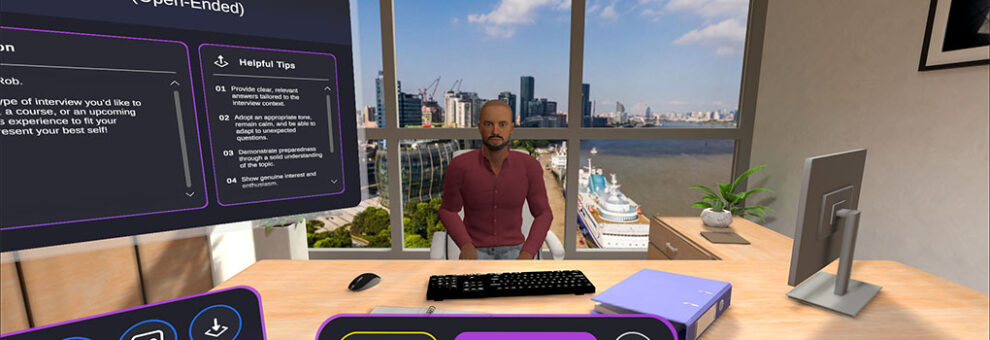
VR is especially powerful for soft skills. Students can practice a job interview, a sales pitch or a difficult conversation in a realistic setting, with an AI character that responds to what they say and provides feedback on their performance. They can repeat the experience until they feel ready, without the pressure of a real audience.
Confidence and reduced anxiety
Practicing in front of a virtual audience helps students who are anxious about public speaking build confidence gradually, before they face a real room.
Access to expensive equipment and environments
Lab equipment, clinical settings and specialist facilities are limited and costly. VR simulations let more students practice with the same scenarios, more often, at a lower cost per student.
Collaboration across distance
Shared virtual spaces let students in different locations work together on projects and presentations as if they were in the same room, supporting international programs and remote learners.
Employability
All of the above adds up to students who arrive at their first job having already practiced the conversations and tasks it involves.
Examples of VR in higher education
IE Business School: VR in the curriculum at scale

IE Business School in Madrid uses more than 700 VR headsets to support around 2,500 students a year, with headsets loaned out much like laptops. Early, optional use didn’t scale, so IE made immersive practice a compulsory part of the curriculum. In one course, a VR exercise counts for 10% of the grade. Many students then went back voluntarily: they complete an average of 2.2 VR sessions each, and IE has passed 25,000 sessions in total.
Read how IE scaled VR.
ESADE: VR through the library
ESADE business school offers VR content to students, faculty, and staff through its library service, so anyone can borrow a headset and practice key skills, such as presentations and interviews, whenever they need to.
Arizona State University: VR biology labs
ASU’s Dreamscape Learn program teaches biology through immersive VR experiences. ASU has reported higher engagement and better lab grades for students in the VR labs than for those in traditional lab courses.
Medical and nursing schools: difficult patient conversations
Healthcare students use AI roleplays in virtual clinics to practice conversations such as delivering a serious diagnosis, explaining a complex condition or discussing end-of-life care, with feedback on empathy, clarity and structure.
Career services: interview practice
Students upload their resume and a real job description, then practice the interview in VR or in the browser, with feedback on each answer.
Learn more about VR for employability.
Presentation practice
Students rehearse in virtual conference rooms, lecture halls and auditoriums, with feedback on pace, filler words, eye contact and how engaging they sound.
What our VR data shows
We looked at how universities use shared VR headsets on VirtualSpeech in 2026:
- VR is concentrated in universities. Around 78% of sessions on shared VR headsets were at universities and colleges, and about half of all student practice sessions took place in VR.
- Interviews are the top use. Job interviews made up 30% of sessions on shared headsets, followed by leadership and difficult conversations (11%) and sales, pitching and negotiation (11%). Institutions’ own scenarios made up much of the rest.
- Language is no barrier. 48% of sessions on shared headsets were in a language other than English.
- Headsets sit idle more than you’d expect. A typical shared headset was used on just 6 days this year, for about 2 sessions each day. A few were used heavily.
That last point is the biggest lesson for VR lab owners. The value of VR depends less on how many headsets you buy than on how often they’re used.
Why add browser access to your VR lab
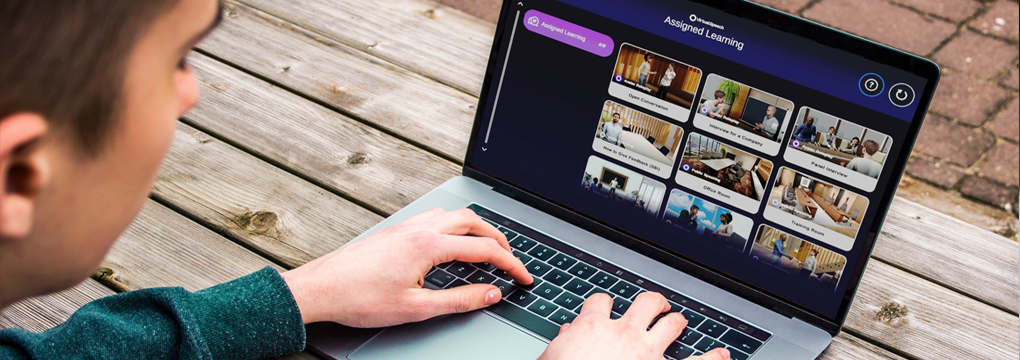
VR labs work best for scheduled, in-person sessions: a class, a workshop, a launch event. Between those sessions, students can’t practice unless they come back to the lab. Giving students the same practice in a web browser solves that:
- Students can practice again from home, which our data shows is where most improvement comes from.
- Remote, part-time and placement students get the same access.
- Students who find headsets uncomfortable have an alternative.
- Usage, and value for money, goes up without buying more hardware.
The simplest model is VR for the immersive first experience in class, and browser practice for the repetition afterwards.

VR for online and blended learning
Online courses scale well but often struggle with engagement, isolation and a lack of hands-on practice. VR addresses each of these:
- Presence. Learners feel they are in a shared space with a lecturer and classmates, not watching a screen.
- Social learning. Avatars, spatial audio and shared virtual rooms let remote students discuss, collaborate and network.
- Experiential practice. Students can do as well as watch: run a simulation, rehearse a presentation, practice a conversation.
- VR plus generative AI. AI characters that respond naturally turn VR from a pre-scripted experience into realistic practice, with feedback after every attempt.
The most practical setup for most universities is blended: VR for immersive, high-impact sessions, and the same practice available in the browser for students learning remotely.
VR across other subjects
Beyond communication skills, universities and schools use VR to explore anatomy and biology in 3D, visit historical and cultural sites, study space and physics, learn languages through conversation, and let students build their own virtual worlds. The range of educational VR apps changes quickly, so choose tools that are actively maintained and run on the headsets your institution already manages.
Challenges of VR in education, and how to solve them
- Cost. Headsets, content and support add up. Start with a pilot in one course, share headsets through a loan system rather than buying one per student, and judge value by cost per session, not cost per headset.
- Managing the hardware. Charging, updates, storage and hygiene take real effort. Device management software and a loan system run by IT make it routine, and someone should be on hand for setup in early sessions.
- Comfort and motion sickness. A small number of students feel unwell in VR, mostly in scenarios with a lot of movement. Seated, conversation-based scenarios rarely cause it. Keep sessions to 10 to 20 minutes, and offer a browser alternative.
- Content that fits the course. Generic VR apps rarely match learning outcomes. Choose content you can adapt, or build scenarios around your own course material.
- Usage drops after the novelty. In our data, a typical shared headset was used on just 6 days this year. Making VR part of assessed coursework, as IE did, keeps it in use.
- A changing headset market. The consumer headset market has slowed, and manufacturers have changed their business offerings. Choose a platform that runs on several devices and in a web browser, so your content isn’t tied to one headset.
How to scale VR on campus
Buying headsets is easy. Making them part of everyday teaching takes an operating model. From IE Business School’s experience:
- Treat VR as a learning tool, not a tech project, with clear ownership and processes.
- Share headsets through a loan system run by existing IT services, rather than one headset per student.
- Use device management software to keep every headset updated and loaded with only the apps a course needs.
- Plan staffing so someone is in the room to help with setup and troubleshooting.
- Coordinate faculty, timetables, and headset loans like any other required course material.
- Make practice part of the curriculum. Optional use doesn’t scale; assessed use does.
For the full breakdown, read 6 keys to scaling VR in higher education.
Frequently asked questions
How is virtual reality used in higher education?
For immersive labs and simulations, practicing interviews, presentations and professional conversations, healthcare communication training, collaboration across campuses, and online and blended courses.
What are the benefits of VR in education?
Learning by doing, realistic practice for real-world skills, reduced anxiety, access to expensive environments and equipment, collaboration across distance, and better-prepared graduates.
Is VR still growing in education?
Yes, where it is used well. On VirtualSpeech, VR practice sessions grew 50% and 93% year on year in the first half of 2026, led by universities.
How many VR headsets does a university need?
Fewer than you might think. Shared headsets on a loan system can serve thousands of students, and adding browser access means students can keep practicing between lab sessions.
Is VR still used in education?
Yes. Consumer interest in VR has cooled, but use in education keeps growing where it’s part of the curriculum. On VirtualSpeech, VR practice sessions grew 50% and 93% year on year in the first half of 2026, led by universities. Many now pair VR labs with browser access, so students can keep practicing outside the lab.
Which schools are using VR for teaching?
Examples include IE Business School, which supports around 2,500 students a year with more than 700 headsets; ESADE, which lends headsets through its library; and Arizona State University’s VR biology labs. Many medical and nursing schools and career services also use VR for communication practice.
Which VR headset is best for education?
Most universities use standalone headsets, such as the Meta Quest range, because they don’t need a computer. More important than the model: support for device management software, comfort for longer sessions, easy cleaning, and whether the content you need also runs in a browser.
How we did this analysis
VR growth figures come from VirtualSpeech platform analytics for AI roleplays and presentations, excluding internal and demo accounts. Lab usage figures come from shared VR headset logins on VirtualSpeech from January 1 to October 13, 2026. Shared logins mean we count sessions, not people. All data was anonymized and aggregated.
Related reading: