

Back in 2016, two entrepreneurs, Sophie Thompson and Dominic Barnard, decided they wanted to use technology and VR to help people overcome the common fear of public speaking, inspired by Sophie’s own struggles. VirtualSpeech was born.
Ten years later, Sophie and Dominic are still at the helm as co-founders, leading a team of 20 people and bringing soft skills development to organizations across the globe. What started with a smartphone, a cardboard VR headset, two practice rooms, and an idea for making public speaking practice more immersive has evolved into a platform combining VR, AI, immersive learning, web-based training, and LMS integrations.
Today, VirtualSpeech has helped learners complete 350k practice sessions across 130+ countries and develop key human skills, from communication and leadership to the skill where it all began: public speaking.
While the technology has changed dramatically over the past 10 years, the goal has remained the same: finding better ways for people to practice the human skills they need in work and in life. From creating a safe space to practice in VR, to using Generative AI for realistic conversations and personalized coaching, every step has been about making practice more effective, accessible, and relevant to learners.
As VirtualSpeech celebrates 10 years, let’s look back at 10 milestones that helped shape that journey.
2016 – Where It All Began: Google Cardboard
The first VirtualSpeech iteration “close” to the current offering was built for Google Cardboard. At the time, Cardboard was an accessible entry point to VR, especially when modern VR headsets were still far from a consumer-friendly price point. Users simply slid their phone into a cardboard headset to experience immersive 3D environments through apps designed for its lenses.
The original app was understandably much simpler than VirtualSpeech today. It featured just two rooms for practicing speeches: a meeting room and a conference room. After completing a speech, learners received basic feedback on their performance.
Even in this early form, the experience established a principle that remains central to VirtualSpeech today: practice needs to give learners a safe space to develop skills. With head tracking allowing learners to look around the environment, they could practice speeches while experiencing an audience and space around them, adding a layer of realism that traditional practice could not easily provide.
Why it mattered: This was the beginning of VirtualSpeech’s approach to using technology to create better ways to practice human skills. The technology was basic, but the goal was already clear: give people a safe environment where they could practice skills they might otherwise find difficult to develop in real life.

2017 – From Practice Exercises to a Public Speaking Course
Originally offering just practice exercises, in 2017 VirtualSpeech launched its first Public Speaking course, combining VR practice with theory through self-paced online modules to create a more complete learning experience.
Public Speaking remains one of the most popular skills we offer. The course has gone through several versions since then and is now rebranded as Public Speaking Mastery, continuing to evolve alongside the learning methods and frameworks we have developed over the years.
Why it mattered: This marked an important step in the evolution of VirtualSpeech, bringing knowledge and active practice together in one learning experience. Rather than simply giving learners a space to practice, we were beginning to build a more complete approach to developing human skills.

2019 – Won Our First Major Learning Industry Award
In 2019, VirtualSpeech won the Start-up Learning Provider of the Year Award at The Learning & Performance Institute (LPI) Learning Awards, an important early recognition from the learning and development industry.
The award came at a time when immersive technology was still relatively new to workplace learning. Being recognized alongside established organizations and learning providers helped demonstrate that VR training could be more than an interesting new technology; it could be a serious approach to developing people.
Why it mattered: This was an important step in establishing VirtualSpeech within the learning technology space. Our work was no longer just about proving that VR could create a different way to practice, but showing that it could have a meaningful place in professional learning and development.
2020 – Making VR Training More Accessible With Oculus Go
In 2020, VirtualSpeech launched on Oculus Go, one of the earlier commercial standalone VR headsets on the market. Unlike earlier VR experiences that relied on a smartphone, gaming PC, or console, Oculus Go offered a standalone way to access VR, making immersive training considerably easier to deploy.
This was an important shift for the wider VR industry, particularly as interest in using VR for learning and development was growing. For organizations and educational institutions, a standalone headset offered a more practical way to introduce immersive technology into training. Research was also beginning to demonstrate the potential of VR for workplace learning. PwC’s Seeing is Believing report, published in 2020, found that VR learners learned up to four times faster than classroom learners and were 275% more confident in applying what they had learned, while also highlighting the potential for VR to become more cost-effective at scale.
For VirtualSpeech, this created an opportunity to bring our public speaking training to a much wider audience. The Oculus Go also provided a more immersive experience than our earlier smartphone-based VR offering, with a dedicated display, built-in tracking, and a standalone design that allowed learners to practice in virtual environments without needing additional hardware.
Why it mattered: Oculus Go helped VirtualSpeech move beyond being a VR app that individuals could try and toward becoming a more accessible training solution for organizations. As VR became easier to adopt and the evidence for its effectiveness grew, we could deliver practical soft skills development to learners at a much greater scale.
2022 – From Two Founders to Our First Full-Time Hire
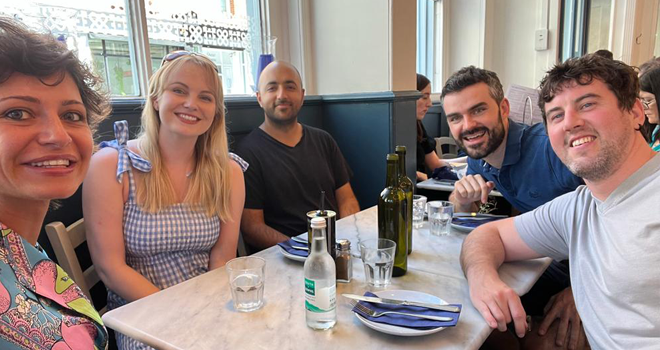
By 2022, the VirtualSpeech team had still been just Sophie and Dom, supported by contractors who helped fill skill gaps and manage the demands of a growing business. That changed when VirtualSpeech hired its first full-time team member, who joined the organization in the sales department.
This was the beginning of a new chapter for VirtualSpeech. Moving from a two-person founder team to a growing business with employees brought new skills, greater capacity, and more flexibility to develop the product and support customers. By the end of 2022, VirtualSpeech was a team of 5.
Why it mattered: This was the point where VirtualSpeech began to evolve from a founder-led business into a growing company. Bringing the first full-time employee into the team created the foundations for the expertise and capacity needed to scale the product and the business.

2023 – When Gen AI Changed the Way We Practice
In 2023, VirtualSpeech introduced Generative AI into its roleplay conversations. For the first time, learners could have open workplace conversations with an AI avatar, either Hugh or Cynthia, and receive feedback on how the conversation went.
Previously, roleplays followed a pre-scripted, branching structure, meaning the possible responses and outcomes were predetermined. Generative AI changed this completely. Learners could respond naturally, without knowing exactly how the conversation would unfold, creating a much more flexible and realistic way to practice workplace scenarios.
VirtualSpeech was also the first VR training app to incorporate Generative AI into its offering. As the technology developed, so did what we could offer learners. Today, VirtualSpeech has over 55 off-the-shelf roleplays and AI-enhanced exercises across more than 20 environments, with 10 AI avatars representing a range of demographics. Multi-avatar roleplays also allow learners to practice scenarios where AI characters can interact with each other as well as the learner.
Gen AI also became the foundation for our custom authoring tool, Roleplay Studio, helping enterprises create their own roleplays and feedback criteria for specific training needs. In 2026, Roleplay Studio was updated with Easy Generate, making it even simpler to create custom roleplays.
Why it mattered: Generative AI fundamentally changed what was possible with practice. Instead of learners following predetermined conversations, VirtualSpeech could create dynamic, responsive scenarios that adapted to what learners actually said, laying the foundations for many of the AI-powered experiences we offer today.

2024 – Grew the Team to 15 Full-Time Employees
By 2024, VirtualSpeech had reached 15 full-time employees, with the team roughly split 50/50 between product and commercial roles.
This growth reflected the changing needs of the business. The team now had dedicated expertise focused on building and improving the learning experience, alongside people focused on bringing VirtualSpeech to organizations and supporting our growing customer base. Offering remote working also meant VirtualSpeech could hire from a wider pool of talent, bringing together skilled and passionate individuals from different locations.
Why it mattered: Reaching 15 employees demonstrated how far VirtualSpeech had grown from its two-founder beginnings. Building both product and commercial expertise gave the business the people and structure needed to continue developing the platform while expanding its reach.2025 – From Feedback to Reflection: Launching the AI Coach
Up to this point, VirtualSpeech had designed its exercises around the concept of Practice > Feedback > Apply. Learners would practice a skill, receive instant feedback on their performance, and then be expected to apply that feedback in their next practice session or in a real-world situation.
However, we realized that receiving feedback alone wasn’t always enough. Even with clear scoring areas and detailed written and audio feedback, learners needed an opportunity to understand what their feedback meant, identify what they could improve, and consider how to approach their next attempt.
In 2025, we introduced an additional step to the VirtualSpeech Learning Cycle: Reflect. This created the cycle we use today: Practice > Feedback > Reflect > Apply.
The AI Coach became the tool that enabled this additional step. After each practice exercise, learners could have a personalized coaching session focused on their performance and feedback. They could ask questions, explore their strengths and weaknesses, reflect on what happened during the exercise, and receive recommendations for additional training.
This also saw a significant change for our AI avatars. Hugh, one of our original roleplay avatars, became the AI Coach, moving from being a conversation partner to helping learners make sense of their performance.
Why it mattered: The AI Coach changed VirtualSpeech from simply giving learners feedback to helping them understand and act on it. It strengthened the learning experience by creating a dedicated space for reflection, making Practice, Feedback, Reflect and Apply a continuous cycle rather than a series of separate steps.
March 2025 – 100,000 Exercises Completed
In March 2025, VirtualSpeech reached a major usage milestone: learners had completed 100,000 practice exercises since the platform launched.
This milestone reflected the growing use of VirtualSpeech across enterprise and education settings, as learners increasingly used the platform to focus on specific skills and practice exercises rather than simply completing traditional courses.
By September 2026, that number had grown to more than 350,000 completed exercises. In just 18 months, learners had completed more than 250,000 additional exercises.
Why it mattered: 100,000 completed exercises showed that VirtualSpeech wasn’t simply being explored by learners, but actively used for practice. Reaching 350,000+ exercises just 18 months later demonstrates how quickly that usage has continued to grow.
2025/2026 – 12.58 Billion AI Tokens and Counting
One thing our clients often praise us for is our simple, set-cost licensing model. Unlike platforms that charge based on AI usage, VirtualSpeech licenses are not capped by the number of tokens learners use, making it easier for L&D teams to justify and manage their investment.
That means we can see just how much AI-powered practice is taking place across the platform. Over the past 12 months, VirtualSpeech has processed 12.58 billion AI tokens through learner interactions.
To put that into perspective, that’s roughly 9 billion words. That’s the equivalent word count of around 300 Lord of the Rings trilogy film scripts, 15,000 complete runs of The Office (US), or enough words to fill nearly 19 million newspaper front pages.
It’s also the equivalent of around 1.2 million hours of spoken conversation, based on an average speaking rate of 130 words per minute. That’s 137 years of continuous conversation. No breaks, no sleeping, just talking.
Why it mattered: This shows the scale at which AI-powered practice has become part of the VirtualSpeech experience. From the first AI roleplays with Hugh and Cynthia in 2023 to billions of tokens being processed today, AI has gone from an emerging technology to a core part of how learners practice, receive feedback, reflect, and improve their soft skills.

10 Years In, We’re Just Getting Started
Looking back at 10 years of VirtualSpeech, it’s clear just how much has changed. What started with a smartphone, a piece of cardboard, two practice rooms, and an idea for helping people overcome their fear of public speaking has evolved into a platform combining AI, immersive learning, web-based training, and more.
But while the technology has changed, our purpose hasn’t.
From our earliest VR practice exercises to AI-powered roleplays, personalized coaching, and hundreds of thousands of completed practice sessions, every milestone has been part of the same journey: finding better ways for people to practice and develop the human skills they need to communicate, lead, and work effectively.
Over the last 10 years, we’ve grown from two founders experimenting with VR into a team of 20 supporting more than 1 million learners across 175+ countries. We’ve seen technologies come and go, watched the way people learn evolve, and continually adapted VirtualSpeech to meet those changing needs.
And we’re not finished yet.
The next 10 years will bring new technology, new challenges, and new opportunities to rethink how people learn and practice. Whatever comes next, we’ll keep the same goal at the heart of it: helping people build better human skills through better ways to practice.
Here’s to the next 10.


