
Training program · Leadership & management
Feedback and Performance Conversations
Help managers give specific feedback, talk through a performance gap and agree a clear next step, by practicing the conversation with AI before they have it for real.
Each learner prepares for a conversation they actually need to have: a missed handoff, a slipping target, or a behavior worth reinforcing.
About 2 h 20 min · 5 lessons
5 practice activities with instant AI feedback
Assigned by you, done at each learner's pace
Online, runs in the browser
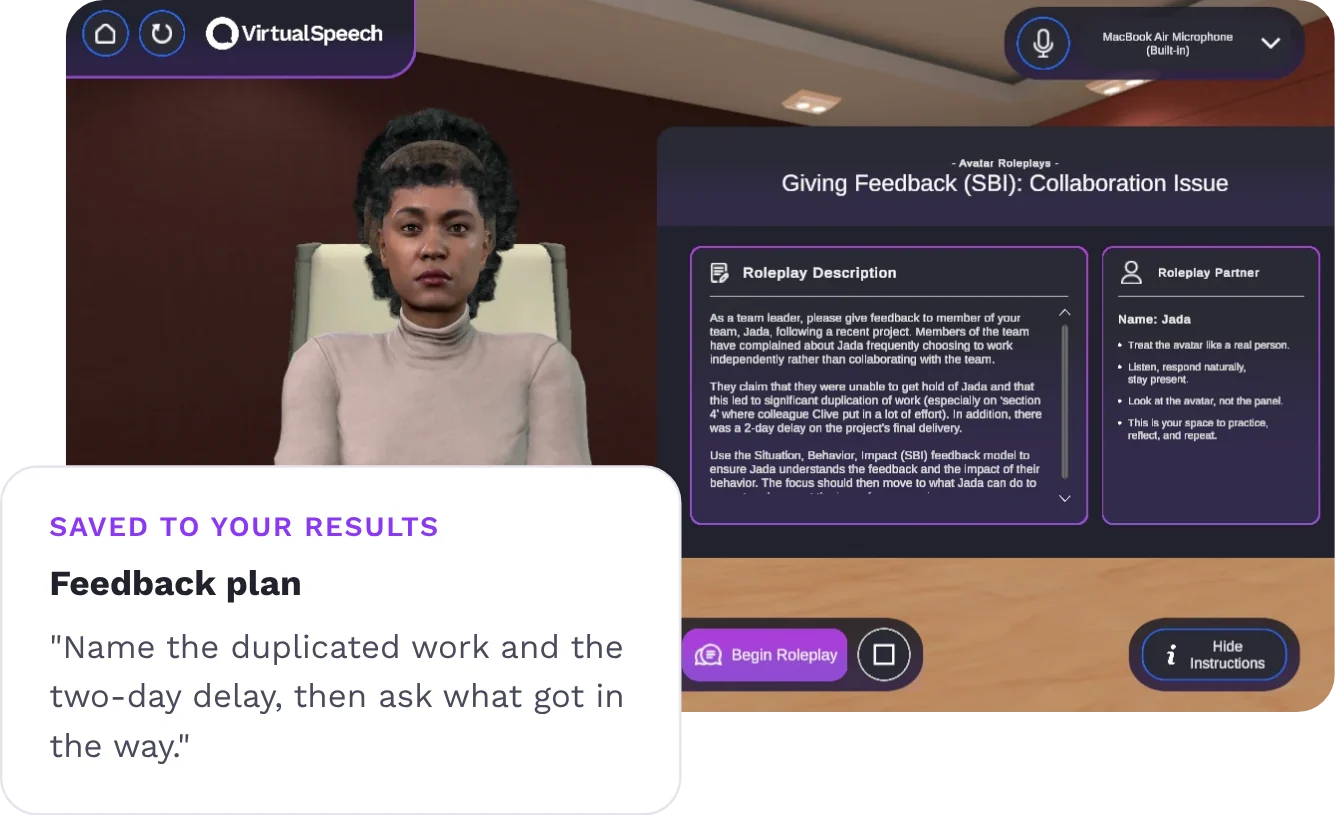
How learners practice feedback conversations
Most managers know feedback should be specific. The hard part is the conversation itself: the opening line, the reply they didn't expect, and agreeing what happens next. Learners practice exactly that, with their coaching and feedback saved so each attempt builds on the last.
Prepare the opening with a coach
After a first attempt, each learner brings their own anonymized situation to Hugh, the AI coach. Together they separate what was observed from what was assumed, tighten the opening and choose a question that invites the other person's view.
- Built around a conversation they need to have
- Uses the Situation-Behavior-Impact (SBI) model
- Ends with an opening they can say in their own words
- Saved next to their roleplay feedback and transcripts
Example feedback plan - How to Give Feedback (SBI)
The situation
A teammate uploaded their part of a report on Thursday. The agreed handoff was Tuesday, so the editor had one evening instead of three.
Opening
"On the report handoff this week, we agreed on Tuesday and the file came in on Thursday. That left the editor one evening to combine everyone's work. What got in the way?"
Check your facts
You saw the upload date. You heard the editor was rushed. "They didn't care" is an assumption, so leave it out.
Next step to propose
Flag any handoff likely to slip by Wednesday noon, then review on Friday.
Continues...

Have the conversation, including the pushback
Learners speak with AI team members in realistic roleplays: a collaboration problem, a colleague who isn't contributing, and a strong performer whose results have slipped. The other person disputes facts, explains their side or goes quiet.
Feedback arrives in seconds, with a transcript to review. Learners then repeat their first conversation and compare the two attempts.
One real conversation, from first attempt to follow-up
Learners start with a feedback conversation they're likely to face, prepare it with facts and coaching, practice giving specific feedback and agreeing a performance plan, then have their first conversation again. They finish with an opening, a question to ask and a follow-up plan for the real conversation.
Program outline
5 lessons · 5 practice activities · 2 h 20 min
Practice · Roleplay: raise a collaboration concern with a team member after a project, as you normally would.
Practice · AI coaching: prepare your own conversation with Hugh, the AI coach, tightening your opening and choosing a neutral question.
Practice · Roleplay: turn a brief full of assumptions into specific feedback about missed deadlines, and ask what was happening.
Practice · Roleplay: meet a usually strong performer whose results have slipped, and agree an action, your support and a review date.
Practice · Roleplay: have your first conversation again and compare the two attempts side by side.
Built for everyday feedback and performance check-ins. Formal discipline, layoffs and sensitive complaints follow your organization's procedures. For delivering disappointing news, pair it with Difficult Conversations for Leaders.
Assign it when managers start having these conversations
Learners rehearse a conversation they're about to have, so the practice lands when it's needed: a first management role, a review cycle or a leadership module.
L&D leads
Inside a new-manager program
Every new manager practices the conversation, not just the model. Use it as pre-work or follow-up to a workshop.
HR and people teams
Before performance check-ins
Managers rehearse a check-in and agree a clear next step before the review cycle starts.
Professors
In a leadership or management course
Students practice giving feedback on a team project, then use the same steps with their own group.
Run it as a cohort, with a results report at the end
We help you agree a sponsor, set a start date and launch it, then show what changed from each learner's first attempt to their last.
For your team, cohort or course:
Each learner gets
- 5 lessons, about 2 h 20 min
- 4 AI roleplays, including a repeat of their first conversation
- Personalized AI coaching, saved for later review
- A conversation and follow-up plan for the real thing
- A Certificate of Achievement, issued by you
You get
- Progress tracking in the Admin Dashboard
- A cohort results report
- Launch support from our team