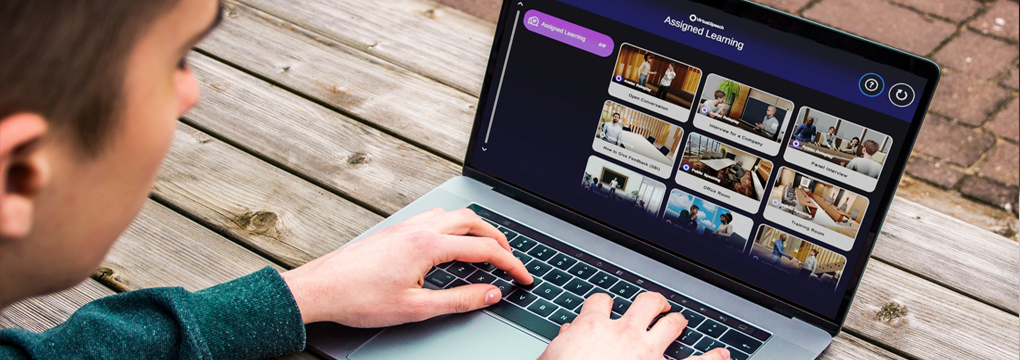
People remember what they do far better than what they read. Immersive learning builds on that: instead of watching a video about a difficult conversation or a safety procedure, learners step into a realistic version of it, act, get feedback and try again.
This guide explains what immersive learning is, why it works, how to stop new skills fading, and where it’s used. It also shares new data from VirtualSpeech practice in 2026 on how timing between practice sessions affects results, and how VR compares with browser-based practice.
What is Immersive Learning?
Immersive learning is an approach that places learners in a realistic, interactive simulation of a real situation, so they learn by doing rather than by reading or watching. It usually uses virtual reality (VR), augmented or mixed reality, or AI-powered simulations in the browser, in which learners talk to AI characters who respond to what they say.
What makes it immersive is a combination of three things:
- Feedback: learners see the consequences of their choices and get guidance on what to change.
- Realism: the setting and the people feel close to the real thing.
- Interactivity: the learner’s actions and words change what happens.
| Traditional e-learning | Immersive learning | |
|---|---|---|
| Learner’s role | Watches, reads, answers quizzes | Acts, speaks, and decides in a realistic situation |
| Best for | Knowledge and compliance | Skills and behavior |
| Feedback | Right or wrong answers | Feedback on what the learner actually did |
| Practice | Rarely repeated | Designed to be repeated |
How immersion improves learning
Experiential learning: Kolb’s cycle at scale
Immersive learning is a form of experiential learning: learning through experience and reflection. The best-known model is David Kolb’s experiential learning cycle, which has four stages:
- Concrete experience: doing something, such as having a difficult conversation.
- Reflective observation: looking back at what happened.
- Abstract conceptualization: drawing lessons and forming a plan.
- Active experimentation: trying the new approach.
Immersive practice covers the whole cycle in minutes. A learner has the conversation, reviews feedback on what they said, plans a better approach, often with an AI coach, then tries again. In our 2026 data, 60% of people scored higher on their second attempt at the same roleplay.
On VirtualSpeech, that cycle looks like this: practice, get feedback, reflect, then plan the next attempt.

It also fits the 70-20-10 model, which suggests people learn about 70% of what they need from experience on the job, 20% from others and 10% from formal training. Immersive practice brings some of that 70% into training, without the risk of learning on real customers or colleagues.

It improves focus
In a VR headset, there are no emails, phones, or second screens. In a realistic browser simulation, the learner has to respond in the moment. Either way, attention stays on the task.
It produces better learning data
Immersive practice records what people actually do, not just whether they finished a module. That includes scores on specific skills, what they said, and, in VR, nonverbal behavior such as eye contact and body language. Trainers can see exactly where each learner, team or cohort needs help.

The forgetting curve: why skills fade, and how practice helps
In 1885, the German psychologist Hermann Ebbinghaus tested his own memory of lists of nonsense syllables at intervals after learning them. He found that memory falls away quickly at first, most steeply in the first hours and days, then levels off. Each time the material is reviewed, the curve flattens and the memory lasts longer. This became known as the forgetting curve, and the benefit of spacing out review is known as the spacing effect, the idea behind spaced repetition.

The forgetting curve was measured for memorized facts, but skills fade without use too. Our practice data shows a similar pattern for conversation skills.
What our data shows
We looked at 7,434 repeat attempts at the same roleplay on VirtualSpeech between May and October 2026, and compared each one with the person’s first attempt, grouped by how long it had been since their previous try.
- After a month, skills slip back. People returning after more than 30 days scored 0.33 below their first attempt.
- Retrying straight away gives the biggest boost. People who tried again within an hour scored 0.77 higher than on their first attempt.
- After a break, the gain shrinks. After 1 to 30 days, scores were only 0.07 to 0.09 above the first attempt: people had kept their starting level, but much of the extra gain had gone.
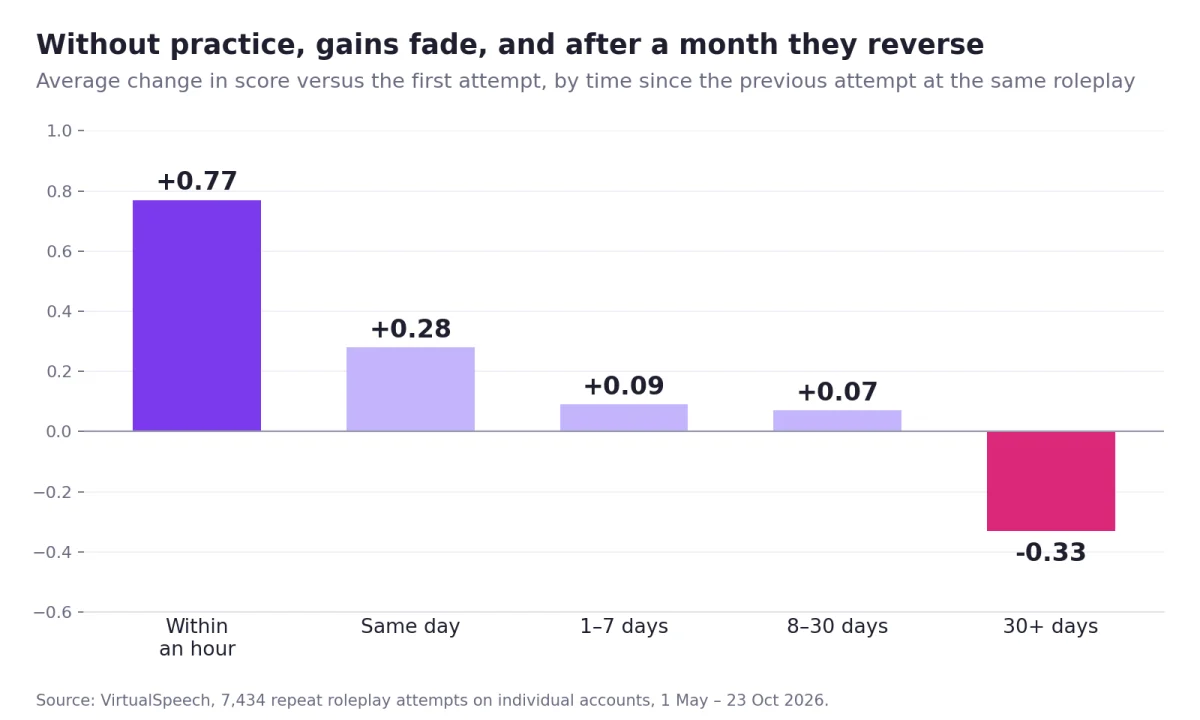
Different people fall into each group, so this isn’t a controlled experiment. People who retried within the hour, for example, had often started lower. But the pattern is consistent with the forgetting curve: practice improves skills quickly, and without regular practice they fade.
How to beat the forgetting curve
- Retry immediately after feedback, while it’s fresh.
- Return within a week to practice the same skill in a new scenario.
- Refresh at least monthly, because our data suggests gains fade after about a month.
- Practice for real moments. A practice session just before a real conversation or presentation helps the skill stick.
- Make it a program, not a one-off. Assigned practice with deadlines is what gets people to come back.
Does immersive learning work?
Research and practice data both point the same way.
- Faster, more confident learners. PwC’s 2020 study of VR soft skills training found VR learners trained up to four times faster than classroom learners, were up to 275% more confident to apply what they learned, and were four times more focused than e-learners.
- Better recall. A 2018 University of Maryland study found people recalled information more accurately in VR than on a desktop computer, suggesting immersion helps memory.
- Skills improve with practice. In our 2026 data, 60% of people scored higher on their second attempt at the same roleplay.
VR vs browser: what our data shows
We compared 15,267 practice presentations on VirtualSpeech from May to October 2026. In every group, presentations practiced in a VR headset scored higher than those practiced in the browser: by 1.3 points for universities, and about 1.1 for organizations and individuals.

Among 65 people who practiced in both, 80% scored higher in VR, by 0.77 points on average.
This doesn’t prove VR alone causes better scores. People may use VR for their more prepared presentations, and browser sessions are often quicker. But it’s consistent with the research: being fully present in a realistic room seems to help people perform. VR also lets you measure what a browser can’t, such as eye contact and body language.
The best programs use both: VR for immersive sessions and the browser for regular, convenient practice.
Examples of immersive learning
Soft skills and leadership
Managers practice feedback, performance and difficult conversations with AI characters who respond realistically, including with pushback. Before practicing, they can plan their approach with an AI coach, then debrief afterwards. See VR soft skills training examples.

Medical and healthcare training
Surgeons rehearse procedures in VR, using platforms such as Osso VR, and nursing and medical students practice patient conversations, such as breaking bad news.

Language Learning
Learners hold real conversations in the language they’re learning, in realistic settings such as a restaurant, a job interview or a meeting, and get feedback on what they said.

Health and Safety
Workers practice hazardous tasks, such as working at height or emergency procedures, in a safe virtual environment before doing them for real.

Education
Universities use immersive practice for interviews, presentations, and clinical communication, often in shared VR labs, alongside browser access so students can practice anywhere. See VR in higher education.
How to design an immersive learning program
- Start with the behavior you want to change, not the technology. For example: “new managers handle underperformance conversations confidently”.
- Choose realistic scenarios that match situations your learners actually face, or build your own.
- Measure a baseline. Have everyone complete one scored scenario before training starts.
- Follow the experiential cycle. Combine practice with reflection and coaching, then require a second attempt.
- Space the practice. Plan a retry the same day, a related scenario within a week, and a refresher within a month.
- Mix devices. Use VR for immersive sessions and the browser for regular practice, so practice isn’t limited to headset availability.
- Make it part of a program, with a cohort, start date and deadlines, rather than an optional library.
- Report results by skill, team and cohort, and use them to plan the next round.
For rollout advice specific to VR, see our guide to VR training.
Frequently asked questions
What is immersive learning?
Learning by doing in a realistic, interactive simulation, often in VR or with AI characters in the browser, with feedback on what the learner actually did.
What are examples of immersive learning?
Managers practicing difficult conversations with AI characters, surgeons rehearsing procedures in VR, students practicing interviews, language learners holding real conversations, and workers practicing safety procedures.
What is the difference between immersive and experiential learning?
Experiential learning is learning through experience and reflection. Immersive learning is one way to deliver it, using realistic simulations instead of real-world experience.
What is Kolb’s experiential learning cycle?
A four-stage model: concrete experience, reflective observation, abstract conceptualization and active experimentation.
What is the Ebbinghaus forgetting curve?
Hermann Ebbinghaus’s 1885 finding that memory fades quickly after learning, most steeply at first, and that spaced review slows the decline.
How do you overcome the forgetting curve?
Space out practice: retry soon after feedback, return within a week, and refresh at least monthly. In our data, skills slipped below their starting level when people returned after more than a month.
Does immersive learning work?
Research such as PwC’s 2020 study found VR learners trained faster and were more confident applying what they learned. In our data, presentations practiced in VR scored higher than in the browser, and most people improved with a second attempt.
How we did this analysis
We analyzed practice on VirtualSpeech between May 1 and October 23, 2026. The forgetting curve analysis uses 7,434 repeat attempts at the same roleplay on individual accounts, comparing each with the person’s first attempt and grouping by the time since their previous attempt. The VR vs. browser comparison uses 15,267 practice presentations, plus 65 people who practiced in both. Shared lab headsets, free trials and internal accounts are excluded. Scores are AI scores out of 10. All data was anonymized and aggregated, and the comparisons show associations, not proof of cause.
Related reading: