

Difficult conversations at work: what 199 real manager roleplays show.
Most advice on difficult conversations at work comes from frameworks and anecdotes. We wanted to see what organizations actually prepare their managers for.
So we looked at every custom roleplay built in Roleplay Studio where a manager or team leader talks to someone in their team. There were 199 of them, written by 78 organizations in 10 languages. They cover retail, banking, energy, healthcare, the public sector, and business schools. Each was written by the organization itself, in its own words, and scored against criteria it chose.
Here is what stood out:
- Underperformance dominates. Almost a third of manager roleplays (30%) are about missed targets, slipping standards or work that isn’t good enough.
- The hardest news gets the least practice. Conversations about promotions, pay, and layoffs make up 6% of manager roleplays but only 1% of practice sessions.
- Organizations score listening far more than accountability. 71% of manager roleplays score listening or questioning. Only 35% score whether the manager set clear expectations or held someone to them. Just 13% score empathy and accountability together.
- The AI employee rarely makes it easy. At least 40% of scenarios tell the employee to start out defensive, make excuses or push back.
- Manager scenarios get reused. 18% of manager roleplays have been copied for use by another team or organization, more than twice the rate for other roleplays (8%).
Below, we break down the conversations organizations are building, what “good” looks like in their scoring, and how to handle the most common ones.
The difficult conversations organizations prepare managers for
Organizations build far more underperformance scenarios than anything else. But what they build and what managers practice are not the same.
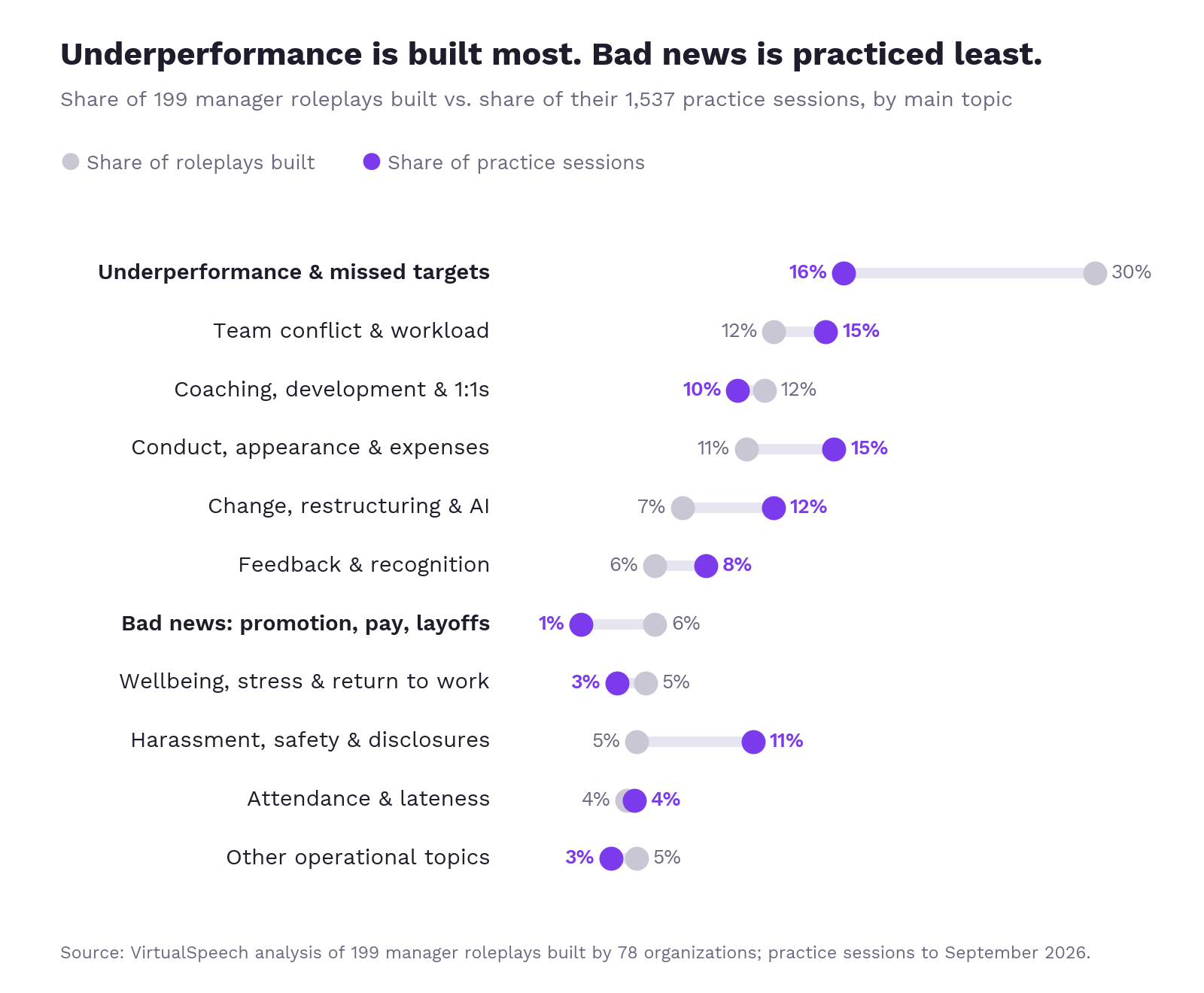
Three patterns stand out:
- Underperformance is built more than it is practiced. It accounts for almost a third of manager roleplays but only about a sixth of practice.
- Change, conflict, and safety punch above their weight. Conversations about restructuring and AI, team conflict, and harassment or safety get more practice than their share of roleplays would suggest.
- Bad news is the gap. Telling someone they didn’t get a promotion, turning down a pay rise, or explaining a layoff are among the conversations managers dread most. Yet they get the least practice of any topic.
This isn’t only a workplace concern. Business schools and universities wrote 16% of these manager roleplays, but their students account for 36% of the practice sessions. They are preparing future managers before they ever lead a team.
How to handle difficult conversations at work
The scoring criteria organizations write are a useful checklist. They show what a good manager does in these conversations. Combine the criteria they use most with the one they often leave out, and you get six steps.
- Prepare the facts and the outcome you want. Write down two or three specific examples, with dates. Then write one sentence on what needs to change. If you can’t, you’re not ready to have the conversation.
- Open with the purpose, in one or two sentences. “I’d like to talk about the last three Monday shifts” is clearer than ten minutes of small talk followed by a surprise.
- Ask before you tell. This is the most commonly scored behavior in our data. Ask an open question, such as “How have the last few weeks been for you?”, and let them answer in full. Many scenarios give the employee a reason they won’t share straight away.
- Name the impact and the expectation. This is the step most often missing from the scoring. Understanding someone’s situation doesn’t mean the standard goes away. Say what the behavior affected and what you need from now on.
- Stay steady when they push back. In at least 40% of these scenarios, the employee starts out defensive. Acknowledge what they’ve said (“I can hear this feels unfair”) and come back to the facts, without arguing about every point.
- Agree on next steps and a date to check in. Make the plan something you agree on together: what changes, what support you’ll give, and when you’ll talk again. 59% of manager roleplays score this.
Difficult conversations at work: examples
These openings come from the conversations organizations build most. Each one states the issue, then asks a question.
| Conversation | Share of manager roleplays | An opening that works |
|---|---|---|
| Underperformance or missed targets | 30% | “Your numbers have been below target for the last two months. Before I say anything else, how do you see it?” |
| Conflict between team members, or workload | 12% | “I’ve noticed things have been tense between you and Sam since the rota changed. I’d like to understand what’s going on from your side.” |
| Conduct, appearance or expenses | 11% | “Two of last month’s expense claims didn’t match the policy. I want to go through them with you and hear what happened.” |
| Lateness and attendance | 4% | “You’ve been late four times in the last three weeks, which isn’t like you. Is something making mornings difficult?” |
| Telling someone they didn’t get a promotion | Part of 6% | “I wanted to tell you myself: the role has gone to another candidate. I know that’s disappointing, and I’d like to talk about what would make you a strong candidate next time.” |
How to have difficult conversations with employees who get defensive
Defensiveness usually means the person feels judged, not that they disagree with the facts. Several scenarios in our data are written so the employee only opens up once the manager stops listing problems and starts asking questions.
Three things help:
- Describe behavior, not character. “The report was two days late” is a fact you can discuss. “You’re unreliable” is a judgment they will defend against.
- Use their words back to them. “So the new system has doubled the time it takes” shows you heard them before you respond.
- Separate the reason from the standard. You can accept the reason (“That sounds like a hard few weeks”) and still keep the standard (“and we still need the reports in by Friday”).
What this means for L&D teams
Building the scenario is the easy part. Getting managers to practice it is harder. 63% of manager roleplays in our data have been practiced at least once. The rest were built but have never been practiced.
The gap is widest where the stakes are highest. Only about half of underperformance roleplays have been used (49%), and fewer than half of those about promotions, pay and layoffs (45%). Scenarios about harassment, safety and sensitive disclosures were all used. That is likely because they tend to be part of a required program with a start date.
Three lessons stand out:
- Run it as a program, not a library. In our experience, scenarios inside a program, with a group of managers, a start date and a follow-up, get used. Scenarios left in a catalog mostly don’t.
- Score accountability as well as empathy. If your criteria only reward listening, managers learn to be kind and still leave the issue unresolved. Add one criterion on stating the expectation clearly.
- Practice the conversations people avoid. Telling someone they didn’t get the promotion is the most-copied manager template in our data, yet bad-news conversations get 1% of practice. Those are the ones to assign first.
Practice the conversation before you have it
VirtualSpeech gives managers a safe place to rehearse these conversations with an AI employee who reacts to what they actually say. Every session is scored against your own criteria, and you can see how each manager’s skills change over time.
See our leadership and management training or book a demo, and we’ll build your hardest manager conversation live on the call.
How we did this analysis
We kept 199 custom roleplays out of several thousand, where the learner plays a manager, supervisor, or team leader and the AI character is someone on their team. We excluded test scenarios and conversations with customers, peers, or senior leaders.
- Topics: each roleplay was given one main topic, based on its title and summary, then checked by hand.
- Scoring criteria: 150 of the 199 roleplays had scoring criteria, with five on average. We grouped similar criteria, so “Active listening: paraphrasing” and “Asking open-ended questions” both count as listening and questions. A roleplay can count in more than one group.
- AI employee behavior: this comes from the instructions each organization wrote for the AI character. Our export shortens long instructions, so these figures are minimums.
- Practice: practice means completed sessions, not people, because some teams share a login.
All data is aggregated and anonymized. We don’t name the organizations or quote their scenarios.


