
Interviews are still about you: your judgment, your communication skills, and whether you can do the work.
But AI can make the preparation process faster, more structured, and far more realistic – especially when you use AI-powered roleplays to rehearse difficult questions, improve your delivery, and build confidence before the real conversation.
This guide shows you how to use AI to prepare for a job interview, with a heavy focus on practicing with AI interview roleplays – so you’re not just “reading tips,” you’re actually training for the moment that matters.
Step 1: Collect what AI needs
AI is only as good as the information you feed it. Before you start, gather:
- The job description (paste the full text, not just a link)
- Your CV/resume (current version)
- 2–4 “proof points” per requirement (projects, achievements, metrics, outcomes)
- Your constraints (notice period, work authorization, location/remote needs, salary range if relevant)
If you do one thing today, do this: create a “story bank” of 6–10 examples from your work or education. You’ll reuse these across almost every interview question.

Step 2: Use AI to research the company and role
Research is still essential, but AI can help you do it with a plan. Use AI to summarize what matters and turn it into talking points you can use naturally in answers.
What to extract from the company website and public info:
- Mission, values, and how they show up in products/services
- Key customers/users and what problem the company solves
- Recent announcements (growth, launches, partnerships)
- How the role supports the business (impact + priorities)
Tip: Ask AI to turn your research into 3-5 “natural sounding” lines you can weave into answers – so you don’t come across like you memorized a brochure.
Try prompts like:
- “Here is the job description and what I know about the company. What are the top 5 priorities for this role in the first 90 days?”
- “Based on the role requirements, what are the most likely interview themes and what evidence should I prepare?”
- “Help me write 6 smart questions to ask that show I understand the role, team, and success metrics.”
Step 3: Build interview-ready answers with an AI ‘story bank’
Most strong interview answers are structured. A simple way to keep your answers clear is the STAR technique: Situation, Task, Action, Result.

Use AI to tighten your stories, not to invent them. Paste your rough notes and ask AI to
- remove fluff
- make the “Action” specific
- add measurable outcomes where possible.
Example prompt: “Turn this into a 60–90 second STAR answer. Keep it natural, add one metric if possible, and end with what I learned.”
Step 4: The fastest way to improve – practice with AI-powered interview roleplays
Reading interview advice helps. Practicing out loud is what changes your performance.
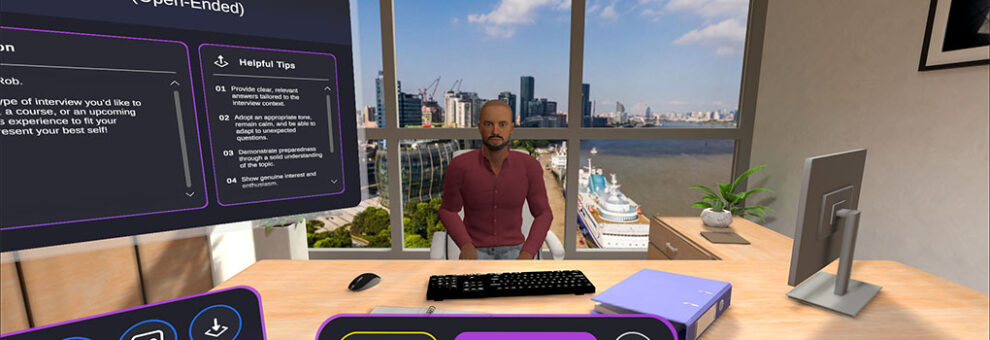
AI-powered roleplays let you rehearse in a way that’s closer to real interviews: you’re responding in the moment, adapting to follow-up questions, and managing pressure—without needing to schedule time with a friend or mentor every time you want to practice.
If you want a structured, interview-specific option, you can practice with VirtualSpeech Job Interview practice or explore the broader AI Practice roleplay library.
What to practice with AI roleplays
Don’t just run through generic questions. Use roleplays to practice the moments that usually derail people:
- Opening minutes: “Tell me about yourself” in 90 seconds, with confidence and focus.
- Behavioral questions: Strong STAR answers, plus handling follow-ups (“What would you do differently?”).
- Pressure questions: Weaknesses, gaps, conflicts, failure, ambiguity.
- Panel interviews: Switching eye-line, staying concise, maintaining energy.
- Company-specific interviews: Answers that clearly map to the role requirements.
VirtualSpeech’s interview practice includes multiple interview roleplays (including resume + job description roleplays, panel interviews, and STAR-focused behavioral interviews) and provides AI-powered feedback and coaching to help you improve across sessions.
How to run an AI roleplay session
Here’s a simple loop you can repeat 3–5 times per week (even in 15–20 minutes):
- Pick one focus (e.g., clarity, conciseness, confidence, handling follow-ups).
- Choose the scenario (general interview, behavioral STAR, panel interview, recruiter screening, or role-specific).
- Do a roleplay without stopping, treat it like the real thing.
- Review feedback with the AI coach: identify your top 1–2 changes.
- Re-run immediately and apply those changes.
That “practice → feedback → repeat” cycle is where AI shines: you can get reps in quickly, fix a specific issue, and track improvement over time—without waiting for someone else’s availability.
Make the roleplay harder
Once you’re comfortable, intentionally increase difficulty. Ask the AI interviewer to:
- interrupt you once (politely) and see if you can recover
- push for specifics (“What was the exact impact?”)
- challenge your assumptions (“Why did you choose that approach?”)
- ask a surprise question that’s still relevant to the role
Training under mild pressure builds the skill you need most in interviews: staying calm while thinking clearly.
Practice interview skills with AI-powered avatars in VR or online. Explore job interview roleplays.

AI Coach – Reflect, Refine, and Improve After Every Roleplay
Practicing with AI-powered interview roleplays is powerful, but the real growth happens when you reflect on your performance. That’s where an AI Coach comes in — think of it as your personal interview mentor who helps you unpack what happened in practice, explore your feedback in detail, and turn those insights into real improvements. :contentReference[oaicite:0]{index=0}
After each AI roleplay session, the AI Coach engages you in a two-way dialogue about your performance — not just telling you what to improve, but helping you understand why and guiding you on how to improve it. This reflection step makes practice more than repetition; it turns it into progress.
Here’s what the AI Coach can help you with:
- Understand your feedback: Explore the feedback you received from the roleplay in a meaningful conversation, helping you see patterns and areas for growth.
- Refine key responses: Go deeper on tricky moments — the AI Coach can help you revisit and improve answers while they’re still fresh.
- Translate practice into action: Turn insights into concrete next steps so you enter your real interview more prepared and confident.
The AI Coach isn’t limited to interviews — it works with all roleplays and practice formats (online or in VR), including custom scenarios you build. By reflecting on your performance right after practice, you can continuously sharpen your delivery, content, and confidence.
Step 5: Prepare for common questions (and rehearse them out loud)
AI can help you generate answers, but you still need to deliver them smoothly. Use it to shape answers, then use roleplays to own them.
“Tell me about yourself” (2 minutes max)
- Start with your current “headline” (role + years + specialty).
- Give 1–2 proof points aligned to the job description.
- Finish with why you’re interested in this role.
“What’s your biggest weakness?”
- Choose a real weakness that won’t break the job requirements.
- Explain how you’re addressing it (system, habit, training, feedback loop).
- Keep it short.
“Why should we hire you?”
- Mirror the top 2–3 requirements from the job description.
- Attach proof: “Here’s what I did, here’s the result.”
- End with confidence, not arrogance: “That’s why I’m confident I’d deliver value quickly.”
Then, take these answers into an AI roleplay and let the interviewer ask follow-up questions, because that’s where most people start to ramble or lose structure.
Step 6: Prepare strong questions to ask
Good questions signal maturity and genuine interest. Use AI to create a list, then edit it so it sounds like you.
High-signal questions (examples):
- “What does success look like in the first 30/60/90 days?”
- “What are the biggest challenges the team is facing right now?”
- “How do you measure performance for this role?”
- “What would make someone struggle in this position?”
- “How would you describe the team’s working style?”
Avoid questions you could answer in 30 seconds on the company website. If you’re going to ask something basic, make it sharper: instead of “What does the company do?”, ask “How does the company differentiate from competitors in this area?”
Step 7: Plan the practical details
Interview performance drops when your brain is managing logistics. Use AI as a checklist builder for your specific interview type (in-person, phone, video, panel) and prepare the day before.
For in-person interviews: plan your route, add buffer time, and choose your outfit in advance.
For video interviews: test your camera/mic, lighting, background, and internet connection. Do one AI roleplay on camera so you can spot distracting habits (eye-line, fidgeting, talking too fast).

Step 8: Use AI practice to manage nerves and improve confidence
Nerves are normal. The goal isn’t to eliminate them, it’s to stay clear and present while they’re there.
AI roleplays help because they create exposure: the more times you experience interview pressure in practice, the less intense it feels in real life. Start with easy scenarios, then work up to tougher ones (panel interview, skeptical interviewer, rapid follow-ups).
Simple ways to calm your body before the interview:
- Slow breathing for 60 seconds (long exhale).
- Relax your jaw and shoulders (most people tense both).
- Stand tall for a moment before joining the room/call.
- Speak slightly slower than you think you should.
If you tend to rush, roleplays are the quickest fix: you can train pacing and clarity repeatedly until it becomes your default.
Step 9: After the interview – use AI to follow up and improve for next time
When the interview ends, you still have two opportunities:
- The thank-you email (short, specific, and value-focused)
- The review (capture what happened while it’s fresh)
Ask AI to draft a thank-you email that references something you discussed and restates the value you bring. Then edit it so it sounds like you and keep it concise.
Finally, debrief with AI: paste your notes and ask, “What did I do well, what likely felt unclear, and what should I practice for the next round?” Then run another roleplay targeting that exact weakness.
A simple AI interview prep plan you can follow this week
Day 1: Build your story bank + draft STAR answers with AI.
Day 2: Research the company + generate questions to ask.
Day 3: Do 2 AI roleplays (general + behavioral). Review feedback and repeat once.
Day 4: Do 1 harder roleplay (panel or company-specific). Tighten your top 3 answers.
Day 5: Full simulation (one uninterrupted run). Prepare your follow-up email template.
Interview preparation doesn’t have to be vague or overwhelming. With AI, you can research faster, structure your answers, and, most importantly, practice realistic conversations until you feel ready.